
Introduction:
Think about it for a moment — when you want to buy something, do you open your laptop first? Or do you pull out your smartphone and search right away? You already know the answer. And that single habit is completely redefining the world of digital marketing as we know it.
Bangladesh currently has over 120 million internet users, and nearly 90% of them access the internet through mobile devices. That one statistic sends a clear message — if you want to succeed in the digital business landscape, you must think Mobile-First.
M-Commerce, or Mobile Commerce, is no longer a futuristic concept. It is today’s reality. Brands and businesses that have not yet prioritized the mobile experience are already falling behind in the race. In this blog post, we will explore in depth what Mobile-First marketing means in the context of Bangladesh, why it is urgently important, and how you can apply it practically to grow your business.
What Is Mobile-First and Why Does It Matter More Than Ever?
Mobile-First is a digital strategy where websites, content, and marketing campaigns are designed with mobile users in mind first — and then adapted for desktop screens afterward.
The old approach was: design for the big screen, then make it “responsive” for mobile. That thinking is now completely reversed.
Why Mobile-First Is Non-Negotiable Today
- Approximately 85–90% of total internet traffic in Bangladesh comes from mobile devices
- Google now follows Mobile-First Indexing — meaning if your site performs poorly on mobile, your SEO rankings will drop significantly
- Mobile users abandon a slow website within just 3 seconds of loading
- With smartphones always within reach, purchasing decisions are now made anywhere — at the market, on the road, or right before bed
The Current State of M-Commerce in Bangladesh
M-Commerce refers to the complete process of buying and selling products or services through mobile devices. In Bangladesh, this sector has grown at a remarkable pace over the past few years.
The Digital Payment Revolution
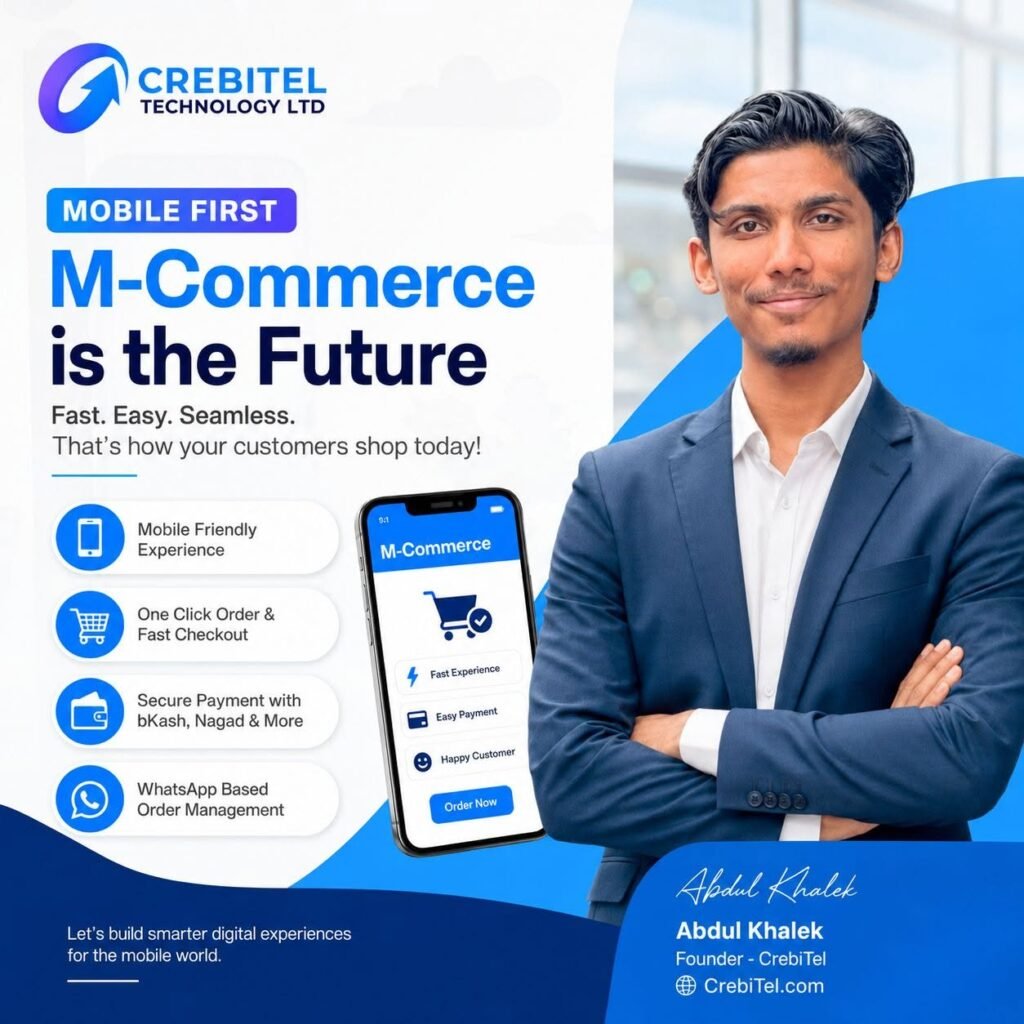
bKash, Nagad, and Rocket — these three platforms have completely transformed the digital transaction landscape in Bangladesh. Today, even a buyer in a remote rural area can complete an online payment with just a few taps.
- bKash: With over 60 million registered users, it is the most widely used mobile payment platform in the country
- Nagad: Leveraging the post office network, it has rapidly expanded into rural communities
- Rocket (DBBL): It bridges traditional banking services with mobile payment convenience
These payment systems have made the checkout process in e-commerce and online services so seamless that many buyers now prefer mobile payments over cash on delivery.
Core Strategies of Mobile-First Marketing
1. Mobile-Friendly Websites and Progressive Web Apps (PWA)
If your website does not display properly on mobile, there is no way to retain customers. A Mobile-Friendly website requires:
- Fast loading speed (within 3 seconds)
- Touch-friendly buttons and navigation
- Readable font sizes and clean content layout
- A simple and frictionless checkout process on mobile
Beyond that, Progressive Web Apps (PWA) have emerged as a game-changing solution. A PWA looks like a website but functions like a mobile app — it works offline, sends push notifications, and can be added to the home screen. In a country like Bangladesh, where internet speed can be inconsistent, PWA dramatically improves the customer experience.
2. In-App Campaigns and Mobile Advertising
Smartphone users spend an average of 4–5 hours daily across various apps. You need to take advantage of this:
- Facebook and Instagram Mobile Ads: Still the most effective mobile advertising channels in Bangladesh
- YouTube Pre-Roll Ads: Video content consumption on mobile continues to rise steadily
- SMS and Push Notification Marketing: The most direct path to reaching customers on their phones
3. WhatsApp-Based Order Management
For small and medium businesses in Bangladesh, WhatsApp has become a powerful sales channel. Through WhatsApp Business, you can:
- Share product catalogs directly with customers
- Receive and confirm orders instantly
- Provide real-time customer support
- Set up automated response messages
Many entrepreneurs are now running their entire business through WhatsApp alone — without even having a website.
4. One-Click Order and Instant Checkout
In modern M-Commerce, the formula “Fast Experience = More Sales” is absolutely true. Research shows that every additional step in the checkout process increases the risk of losing a buyer.
Effective Instant Checkout strategies include:
- One-Click Order: Complete a purchase in a single click using previously saved information
- Guest Checkout: Allow customers to buy without being forced to create an account
- Saved Payment Methods: Store bKash or card details once, removing the need to re-enter them
- Auto-Fill Address: Automatically populate the delivery address from previous orders
5. Personalized Mobile Offers
Using data analytics to study customer behavior, preferences, and purchase history — and then sending personalized offers — is one of the most effective strategies today. For example:
- Sending a reminder when a product is left in the cart without purchase
- Offering a personal discount on birthdays or special occasions
- Recommending products based on previous purchases
Mobile-First Marketing Across Different Industries
Food Delivery
Platforms like Pathao Food and Shohoz Food operate on a completely mobile-centric model. Real-time tracking, mobile payments, and rating systems have brought M-Commerce to full maturity in this sector.
E-Commerce
Platforms such as Daraz, Chaldal, and Shajgoj are generating a major portion of their sales through their own apps and mobile-optimized websites.
Local and SME Businesses
Small ventures operating through Facebook Pages, WhatsApp, and Instagram are making the most accessible use of mobile marketing today.
Subscription Services
OTT platforms, online education providers, and software services are retaining customers through mobile billing and auto-renewal systems.
Common Mobile Optimization Mistakes to Avoid
Many businesses talk about Mobile-First but still make these critical errors in practice:
- Keeping website loading time above 3 seconds
- Using large, uncompressed images that slow down mobile performance
- Using unreadable fonts and cluttered layouts on small screens
- Not offering mobile payment options or making them unnecessarily complex
- Disrupting the mobile experience with intrusive pop-up ads
- Using CTA buttons designed only for desktop screens
The Road Ahead: Mobile Will Be the Primary Battleground
Experts believe that by 2026, the number of mobile internet users in Bangladesh will grow even further. With the expansion of 5G technology, falling smartphone prices, and rising digital literacy, M-Commerce will become even more deeply embedded in everyday life.
Key trends that will shape digital marketing in the near future:
- Voice Search Optimization: People are now searching by speaking — “Ok Google, where can I find biryani nearby?”
- AI-Driven Personalization: Predicting what customers want before they even ask
- Augmented Reality (AR) Shopping: Virtually “trying on” products before buying
- Super App Model: All services within a single app — similar to WeChat or Grab
Conclusion
The equation for digital marketing has become crystal clear — Mobile-First = Business-First. In Bangladesh, the businesses that prioritize the mobile experience today will be the ones that survive and thrive tomorrow.
Simply having a responsive website is no longer enough. What is needed is fast loading, effortless payment, personalized experiences, and a fully mobile-centric marketing strategy. Because today’s customer is not patient — they demand speed, simplicity, and trustworthiness.
Always remember: “Digital Marketing is no longer Desktop First. Now it’s Mobile First, Customer First, and Experience First.”
📣 What Should Your Next Step Be?
Start today by evaluating your business’s mobile experience. Does your website load quickly on mobile? Is the payment process simple and smooth? Do you have WhatsApp or app-based services in place?
If the answer to any of these is “no,” now is the time to change that. Leave a comment below or get in touch with us — we are ready to help you begin your Mobile-First journey and take your business to the next level.
If this blog post added value to your thinking, share it with fellow entrepreneurs who have not yet discovered the full power of mobile marketing.